Your webshop is registered in the Netherlands, and more of the orders now come from Belgium, Germany or France. At some point the question comes up: should you still charge Dutch VAT on them? This guide explains the OSS VAT Netherlands rules for a Dutch webshop. It covers the €10,000 threshold, the order that crosses it, what happens to your prices and margin, and how to register and file with the Dutch tax office. It ends with a checklist and a table you can use to set prices for each country.
NyxWorks is a studio in Amsterdam that builds websites and webshops and manages listings and ads on bol and Amazon. This is general information, not tax advice. Every rule below comes from the Dutch tax office (Belastingdienst), the Netherlands Chamber of Commerce (KVK) and the European Commission. The product and prices in the example are made up to show the maths.
Checked on 11 November 2026. VAT rules, rates and deadlines can change, so confirm the current position with the Belastingdienst or your accountant before you change your prices.
Quick answer
The OSS VAT Netherlands rules in short: a Dutch webshop may charge Dutch VAT on sales to consumers in other EU countries until those sales pass €10,000 in a year. That amount is for all EU countries together, not per country. From the order that crosses it, you charge the VAT rate of the customer's country. You can then report all of that foreign VAT in one quarterly return through the One Stop Shop (OSS) in Mijn Belastingdienst Zakelijk, instead of registering for VAT in every country you sell to.
OSS VAT Netherlands: the €10,000 rule in plain steps
The rules apply when you sell goods from the Netherlands to private buyers in another EU country. Business customers with a VAT number follow other rules and are not part of this guide.
- Add up your foreign EU sales to consumers. According to the KVK, one joint threshold of €10,000 a year applies to all distance sales of goods within the EU, together with digital services to EU consumers. It covers every sale to a consumer, not only orders placed in your online shop. An order taken by phone also counts.
- Below €10,000: you may charge Dutch VAT, as you do for Dutch customers.
- Above €10,000: you charge the VAT of the country where the goods go.
- Report that foreign VAT in one of two ways: register for VAT in each country you sell to, or use the Union scheme of OSS at the Belastingdienst.
Two groups of goods sit outside the threshold. For excise goods such as alcoholic drinks, and for new or almost new means of transport, you charge the VAT of the destination country from the first sale, whatever the amount. Goods sold under the margin scheme are also outside the threshold. On those you pay Dutch VAT on your margin.
What changes at the order that crosses €10,000, and the year after
This is the part of the OSS VAT Netherlands rules that most explanations leave vague. The KVK describes it as a timeline, which looks like this for a shop that crosses the threshold in 2026:
- 2026, before the threshold: Dutch VAT on foreign consumer orders.
- 2026, the invoice that takes you over €10,000: from that invoice on, the VAT of the customer's country. Not from the next month or the next quarter, but from that sale.
- 2027: you keep charging the customer's local VAT for the whole year, even if sales slow down.
- 1 January 2028: you look back at your 2027 foreign sales. Below €10,000? Then you may switch back to Dutch VAT. You may also keep charging local VAT if that is easier for your shop.
In practice this means you need to see the running total before you reach it. A shop that sells €900 a month to Belgian and German customers crosses the threshold in its twelfth month. The KVK advises acting as soon as you are approaching it, because your checkout, invoices and bookkeeping all have to change at that moment.
Example: OSS VAT Netherlands rules on one €100 product
Each EU country has its own standard VAT rate, and many have reduced rates for some goods. These are the standard rates the European Commission's Your Europe portal lists for some common markets for Dutch shops (page last checked by the Commission on 13 July 2026; rates can change).
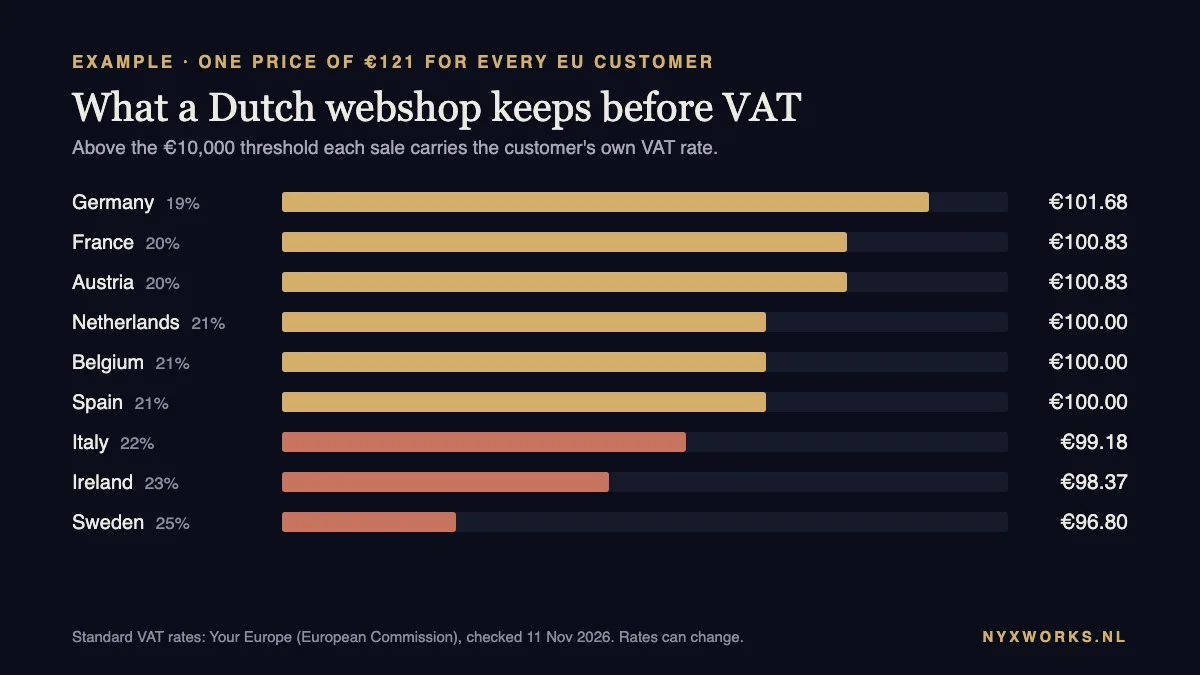
Say your product costs €100 before VAT. Above the threshold, the price a consumer pays depends on where they live. The right-hand column shows what you keep before VAT if you keep one price of €121 for everyone, the Dutch price.
| Country | Standard VAT | Price at €100 net | Net you keep at a fixed €121 |
|---|---|---|---|
| Netherlands | 21% | €121.00 | €100.00 |
| Belgium | 21% | €121.00 | €100.00 |
| Spain | 21% | €121.00 | €100.00 |
| Germany | 19% | €119.00 | €101.68 |
| France | 20% | €120.00 | €100.83 |
| Austria | 20% | €120.00 | €100.83 |
| Italy | 22% | €122.00 | €99.18 |
| Ireland | 23% | €123.00 | €98.37 |
| Sweden | 25% | €125.00 | €96.80 |
Example. Rates from Your Europe, checked on 11 November 2026. Reduced rates apply to some goods: check the rate for your own product.
Two things stand out. A German order at €121 earns you €1.68 more than a Dutch one. A Swedish order earns you €3.20 less. On a product with a 20% margin, that difference is a real part of the profit.
One price for everyone or a price per country?
Once the OSS VAT Netherlands rules apply to your shop, you have to choose how your shop shows prices. Both options are allowed; they suit different shops.
One price including VAT for everyone. The customer sees €121 wherever they are. Simple to communicate and nothing changes on your product pages. The cost is that your net revenue moves with the VAT rate, as the table shows. This works well when most foreign sales go to countries with a rate close to 21%.
A price per country. The shop keeps the net price fixed at €100 and adds the local VAT at checkout. Your margin stays the same everywhere. The cost is a more complex setup: the shop must know the customer's country before it shows the final price. The KVK points out that you can use the customer's address for this, and that your shop or ERP software must invoice and record the correct rate for each country.
Whichever you pick, check three things in your shop software. Does it know the VAT rate per country and per product type? Does it show the right price in the cart before payment? And does it give you a report of sales and VAT per country for each quarter? That report is what you will need for the OSS return.
Registering for OSS in Mijn Belastingdienst Zakelijk
OSS is voluntary: the alternative is a separate VAT registration in every country you sell to. For most small Dutch shops, OSS is the simpler route, because one return covers all countries. The OSS VAT Netherlands registration works like this, according to the Belastingdienst:
- Log in to Mijn Belastingdienst Zakelijk.
- Choose 'EU-btw éénloketsysteem' and then 'Registratie', and fill in your details.
- Part of a VAT group (fiscale eenheid)? Register with the VAT identification number of the company itself, not the number of the group.
- You receive a letter that confirms or rejects the registration. Once confirmed, you take part with your VAT identification number, which the letter calls your 'deelnamenummer'.
When does it start? Normally on the first day of the quarter after your registration. There is one exception that helps a shop that has just crossed the threshold. If it is your first delivery that falls under the scheme, you may report it in OSS straight away, provided your registration reaches the Belastingdienst by the 10th of the month after that delivery. So a shop that crosses €10,000 on 18 November should have its registration in by 10 December.
Quarterly return, payment and records
These are the OSS VAT Netherlands rules for the Union scheme, as set out by the Belastingdienst and the European Commission:
- Every quarter, also a zero return. You file once a quarter, even if you made no foreign sales that quarter.
- Deadline: in the month after the quarter, by the last day of that month. The return for July to September is filed in October and due by 31 October. You may not file before the quarter has ended, and the deadline does not move when it falls on a weekend or holiday.
- Payment: in euros, in one payment for all countries. The Belastingdienst passes the money on to the other countries. If you sold in another currency, use the European Central Bank rate of the last day of the quarter.
After the return is in, three more rules apply:
- Corrections: you cannot resubmit a return. You correct a mistake in a later return, within 3 years of the original deadline.
- No deduction of foreign VAT: VAT you paid on costs in another EU country cannot be deducted in the OSS return. That goes through a separate refund procedure.
- Records: keep all data related to OSS for 10 years after the year of the sale, longer than the normal 7 years, and be able to provide them digitally.
- Invoices: under the Union scheme, Dutch invoicing rules apply. For VAT purposes, you do not have to send an invoice for distance sales to consumers.
If you file no return for 3 quarters in a row, or do not pay within 10 days after a reminder in 3 consecutive quarters, the Belastingdienst excludes you from the scheme for 2 years. A shop that files returns but makes no supplies for 2 years also loses its place in the scheme.
When OSS is not enough: stock abroad
The OSS VAT Netherlands return covers goods you ship from the Netherlands. That changes when your stock sits in another EU country.
According to the KVK, if you store goods in a warehouse in another EU country, you need a VAT number in that country. Sales shipped from that warehouse carry local VAT and go into a local VAT return, not into the Dutch OSS return. The KVK gives the example of a Dutch seller using Amazon's fulfilment service in Germany: Amazon asks for a German VAT number, and sales from German stock to German consumers are local sales.
So before you send stock to a fulfilment centre abroad, plan the extra VAT registration and the bookkeeping that comes with it. Our comparison of bol.com vs Amazon covers the marketplace side of that choice.
Small business scheme (KOR) and OSS
Many starting shops use the small business scheme, the KOR, which exempts businesses with an annual turnover below €20,000 from charging VAT. The KVK explains how the KOR and the OSS VAT Netherlands rules interact:
- If your foreign EU consumer sales stay below €10,000 and your total turnover, Dutch plus foreign, stays below €20,000, you may keep using the KOR. You then charge and report no VAT.
- Once your foreign sales cross €10,000, you owe VAT in the customer's country, and the Dutch KOR no longer covers those sales.
If you use the KOR now, check your foreign total every month. Crossing €10,000 means a sudden switch from charging no VAT at all to charging foreign VAT.
OSS VAT Netherlands checklist for a Dutch shop
Before you reach the threshold:
- Add up your EU consumer sales outside the Netherlands for this year, across all channels.
- Keep a running monthly total and set an alert well before €10,000.
- Check whether you sell excise goods or margin-scheme goods: they follow other rules.
- Choose: one price including VAT for everyone, or a price per country.
When the shop is set up:
- Set the VAT rate per country, and per product type, in your shop software.
- Test the checkout with a Belgian, German and Swedish address.
- Make sure your shop can export sales and VAT per country per quarter.
When you cross it:
- Register for OSS in Mijn Belastingdienst Zakelijk; for a first delivery, before the 10th of the next month.
- Put the quarterly deadlines in your calendar: 30 April, 31 July, 31 October and 31 January.
- Plan a separate VAT registration before you store stock abroad.
- Using the KOR? Check what happens to it before you cross €10,000.
- Keep OSS records for 10 years.
Frequently asked questions
Is the €10,000 threshold per country?
No. It is one threshold for all EU countries together. €4,000 to Belgium, €4,000 to Germany and €2,500 to France adds up to €10,500, which is above the threshold.
Is OSS mandatory for a Dutch webshop?
No. Registering for OSS VAT Netherlands is voluntary. Above the threshold you must charge foreign VAT, but you may choose to register for VAT in each country instead. For most small shops one OSS return is much less work than several foreign registrations.
When is the OSS return due?
By the last day of the month after each quarter: 30 April, 31 July, 31 October and 31 January. You file even when you had no foreign sales that quarter.
Can I deduct foreign VAT in the OSS return?
No. VAT you paid on costs in another EU country cannot be deducted in the OSS return. It has to be reclaimed through a separate refund procedure.
Can I keep using the KOR if I sell abroad?
Yes, as long as your foreign EU consumer sales stay below €10,000 and your total turnover stays below €20,000. Above €10,000 in foreign sales, those sales carry the customer's VAT and the KOR no longer covers them.
Need a shop that gets VAT right per country?
Most of the OSS VAT Netherlands work happens in the shop itself: VAT rates per country, the right price in the cart and a clean report per quarter. At NyxWorks we build that in when we set up a shop. Our fixed-price websites start at €289 for a landing page and €799 for a WordPress site with up to 5 pages, and WooCommerce Care for ongoing upkeep is €109 a month (prices excluding VAT, checked on 11 November 2026, can change). See web development, or start with a 30-minute consultation for €30, which is credited towards a project. Not sure your current shop is ready? Run it through the free website X-ray first.
For the bigger picture of starting out, read how to start a webshop in the Netherlands. Selling on bol as well? The bol margin calculator shows what you keep per order.
Sources
- KVK: VAT rules for e-commerce in the EU (edited 13 October 2026, read 11 November 2026)
- Belastingdienst: Unieregeling, registratie, melding, betaling en administratie (NL) (read 11 November 2026)
- European Commission: Declare and pay in OSS (read 11 November 2026)
- Your Europe: VAT rules and rates (last checked by the Commission 13 July 2026, read 11 November 2026)
Checked on 11 November 2026. VAT thresholds, rates, deadlines and NyxWorks prices can change.
Next step
Want this done for your business?
Tell us what you need. You get a fixed scope and a public price, usually within a day.
Start a project